
Lower Palace Overview
Lower Palace prefaces the final level of Calcium Overdrive and is intended to let players master utilizing chain grapple mechanics, as well as introducing the Milkomancer and boss fight mechanics. When planning out this level I wanted the boss fight to involve the boss spawning enemies. I figured a good way to showcase a spawner fight would be in an arena and coliseums are very noticeable arenas that players could easily recognize. To improve the world building around this main focal point I wanted to create buildings that led upwards to the coliseum with resistance points breaking up the areas. This helped me create the feel of a desolate city that has become overrun with enemies and leads to the main arena that hides the Milkomancer.
Level Tasks
- Level Pre-Production/Planning
- 2D Maps
- Level Pacing/IPM
- Master: Chain Grapples
- Blockmesh/Blockout
- Cinematics/Level Sequences
- Player Guidance (Leading Lines, Breadcrumbs, Guiding Lighting)
- Boss Fight Alterations
- Enemy Spawning System
- Single Path Movement
- Finalized Asset Implementation
- Environmental Storytelling
- World Building
Game Engine:
Unreal Engine 5.2
Project Duration:
4 Months
Project Role:
Lead Level Designer
Pre-Production
Level Overview
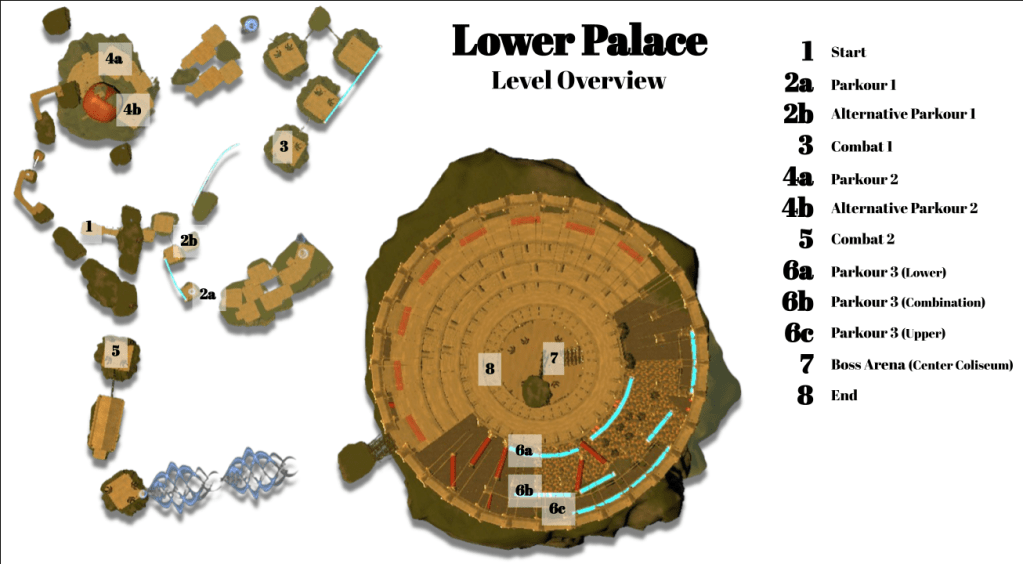
Level Pacing
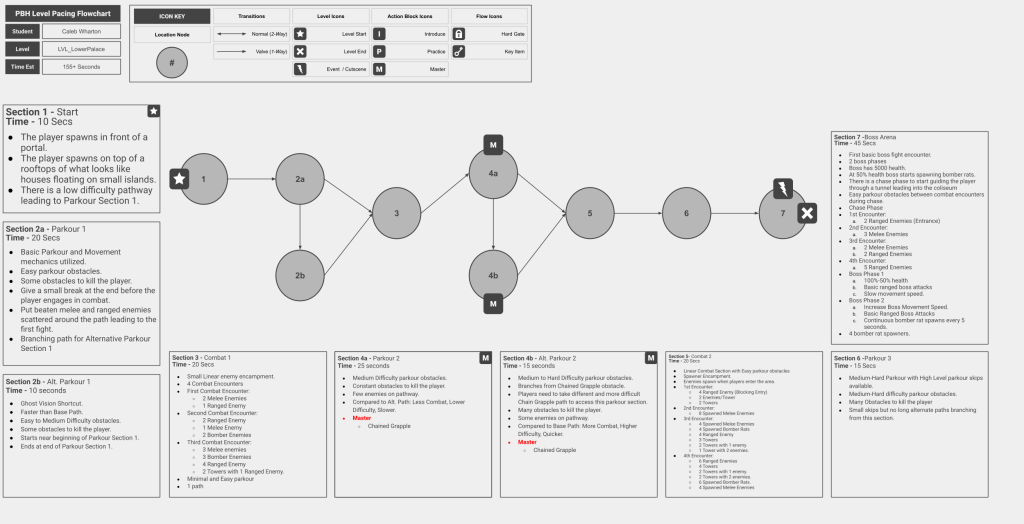
Level Design Analysis
Start
The level starts with the player spawning near a rooftop portal, offering a distant view of a massive coliseum in the background to pique early intrigue.


Travelling Across Rooftops(Parkour Section 1)
The initial Parkour section offers a base and an alternate path. The alternate route links the Parkour section to Combat 1, providing a quicker path if players notice the floating tombstone and Summon Cal. This pathway involves passing through a ghost building, significantly reducing travel time. The base path showcases architectural elements, requiring players to wall run between buildings, climb to rooftops, and use a windstorm to reach Combat Area 1, offering a panoramic view of the first enemy encampment.
Milkomancer’s Initial Stronghold(Combat 1)
Inspired by Elden Ring’s Mountaintop of The Giants, the first Combat section employs thin platforms and chains connecting enemy encampments, serving as guides for players. Introducing simple chain grapple obstacles prepares players for upcoming parkour challenges. These small chain grapple challenges offer alternative routes and player agency for the second combat encounter. Players can choose the spirit path to the right, use chain grapples for the third encounter, or opt for left-hand chain grapples to reach the fourth encounter. This reinforces chain grapple usage before the crucial Second Parkour section, where mastering this mechanic is crucial.


Grapple above the abandoned city(Parkour Section 2)
After discussions with level designers for levels 2 and 3, we decided to introduce and practice the chained grapple mechanic in level 3 and emphasize mastery in level 4. To maintain proper level flow, I placed the chained grapple mastery obstacle in Parkour section 2. This allowed for lower intensity in the first parkour section while intensifying the second section closer to the focal point, the coliseum. The chained grapple obstacle was split into two pathways: the base path, easily visible with fail-safes below allowing players to grapple back up, offering various options to test mastery. The alternate path branches left from the base path, rewarding higher-skill players with a quicker passage through the second Parkour section, while the base path involves lifts and wall-run obstacles to access the second Combat section.
Final Enemy Encampment (Combat 2)
Originally, Combat Section 2 had 4 encounters but proved overly intense after testing. To address this, I removed the fourth encounter and heightened enemy numbers in the second encounter, encouraging players to use their ultimate ability before the third encounter. This increased tension mid-section and allowed for a gradual reduction in intensity leading up to the windstorm toward the coliseum. These adjustments aimed to create a sense of the area as a final stronghold before players reach the coliseum for the boss fight.


Coliseum Entrance (Parkour Section 3)
The initial aim was to lower the intensity at the start of Parkour 3, gradually increasing it as players progressed. However, the vast area accommodating diverse parkour mechanics led to confusion and a lack of guidance. To address this, I divided Parkour 3 into pathways to offer greater player agency and reduce overall openness. Implementing floating lanterns at entrances and fallen pillars for visual guidance effectively directed players and encouraged exploration, significantly improving clarity and player direction.
Coliseum Arena Floor (Boss Fight)
Originally, the boss arena was vast, featuring the boss moving along a single set path. As the first boss encounter, the goal was to intrigue and excite players while offering guidance. To achieve this, I implemented several fixes, greatly enhancing the fight’s flow and creating an exciting experience for players.
- Decrease Arena Size – The primary fix involved reducing the arena’s size. Initially, players frequently lost sight of the boss in the large space, spending significant time trying to locate it. By downsizing the arena, the boss became easier to track and locate if players lost sight of it.
- Boss Spawns Enemies – Employing the logic applied in the level 5 boss fight, I programmed the boss to spawn enemies whose defeat would decrease its health. This strategic change urged players to target not just the boss but also the spawned enemies. Additionally, a text popup informed players that eliminating enemies would reduce the boss’s health, significantly boosting the fight’s intensity and reducing redundancy.
- Lava Attack & Grapple Points – I introduced logic enabling the boss to periodically raise lava, intensifying the gameplay and prompting players to use the grapple points strategically placed around the Boss Arena. Minor tweaks to the grapple point locations significantly enhanced player movement, encouraging the use of parkour mechanics in a more fluid and flexible manner.
- Boss Monolith – In the boss fight, a major concern was the high intensity and limited healing options. Playtesting revealed frequent player deaths or low health at the level’s end. To address this, I utilized different monolith meshes from our artist to introduce an area of effect ability linked to the boss monoliths for healing. I adjusted the healing’s potency and frequency to prevent it from overpowering players, striking a balance that allowed healing while limiting player mobility during the process.
- End Portal Location – Originally, defeating the boss would teleport the end portal to the boss’s death location, but this method had multiple bugs. To meet deadlines and improve player guidance, I reworked the end logic. I relocated the end portal to the opposite tunnel leading to the inner coliseum arena. This placement hinted at the portal’s location for players entering the coliseum and provided a clear point of interest after defeating the boss. Additionally, I implemented logic to lower the gate blocking the portal upon the boss’s defeat, directing players’ attention toward the portal.


Cinematics
In the boss cinematic, I aimed to enhance the narrative and immerse the player by integrating boss dialogue that recurs during the final boss fight. I designed a scene where the boss spawns a portal, passes through it, and vanishes, strengthening the narrative of the boss retreating. Following the end portal would lead players to a location near the boss’s retreat, signaling there’s more to come in the upcoming level despite the boss’s defeat.
 Caleb Wharton